
Top-rated independent heating and cooling across central Arkansas and the Arkansas River Valley
Replacing Half a System
Your outdoor unit quit and somebody told you the indoor half has to go too. That sounds like an upsell. Sometimes it is. Often it isn't. We replace and repair cooling and heating systems for homeowners across Arkansas, Louisiana, Missouri, Mississippi, Oklahoma, Tennessee and Texas, and here is how we decide whether half a system makes sense or whether you are better off doing both.
Call (888) 365-6280- A real person answers
- Open 7 days
- Written quote before work starts
Taking calls until 5:00 PM CT
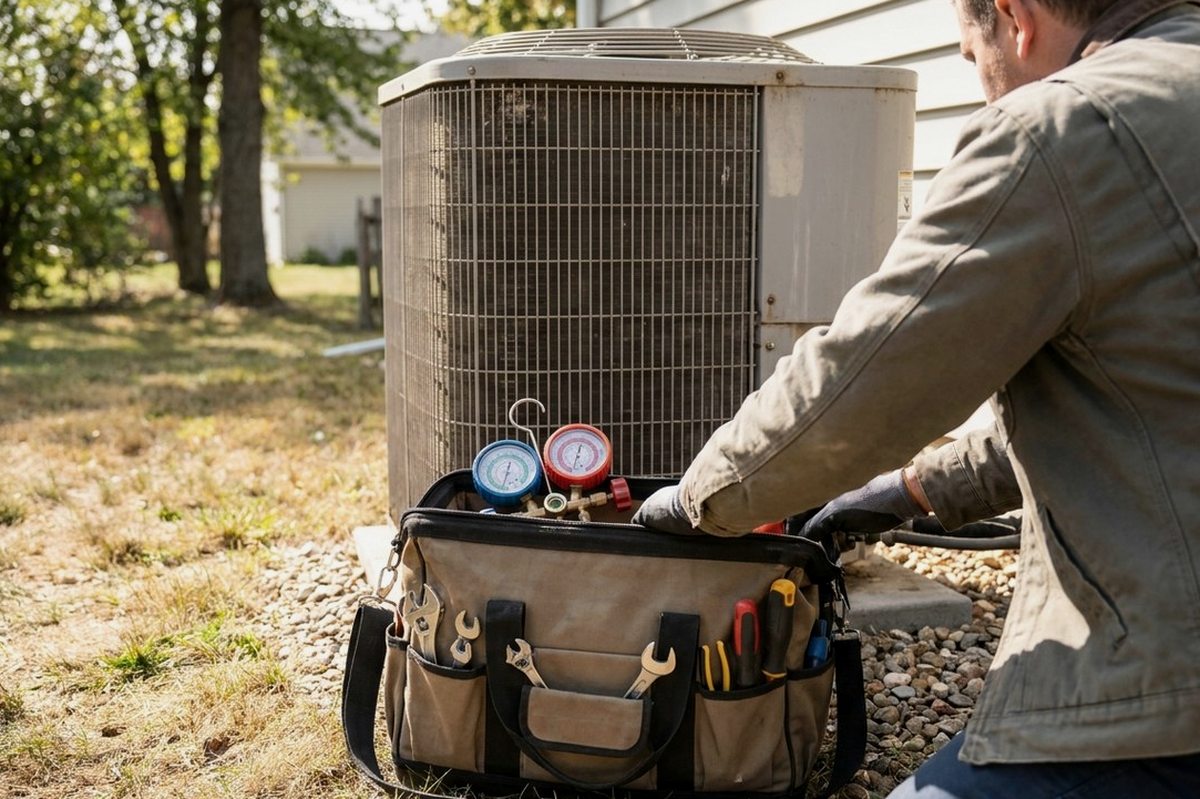
Rock City Air Systems service team · field-reviewed before publishing
What a matched system actually means
A split system has two halves that were designed together. The outdoor condenser or heat pump moves refrigerant, and the indoor coil and blower absorb heat from your air. The two are rated as a pair, with a specific coil, metering device and airflow range. Bolt a new outdoor unit to an old coil and you get a pairing nobody engineered. Sometimes it runs fine for years. Sometimes it runs short cycles, sweats in the attic, or never quite pulls the humidity out of a house on a July afternoon. Newer refrigerants complicate it further, because an older indoor coil may simply not be built for what the new outdoor unit uses.,},{
Age is the first thing we look at
If both halves went in the same week and they are both well past the middle of their service life, replacing one is usually throwing good money after a system that will ask again soon. The tell is not just the label date. It is the condition of the coil fins, the state of the contactor and capacitor, whether the cabinet has rusted through at the base, and how many refrigerant top-offs the system has needed. A system that has been added to twice in three summers has a leak somewhere, and a new outdoor unit does not fix a leaking indoor coil.
The fault matters more than the age
A failed capacitor, a bad contactor, a seized condenser fan motor or a clogged drain line are repairs, full stop, on almost any system that is otherwise sound. A failed compressor or a leaking evaporator coil is where the conversation changes, because those are the expensive halves of each side. We also weigh where the fault sits. A leak in a line set buried in a slab is a different problem from a leak at an accessible braze joint. And attic air handlers in this region take a beating from heat and humidity, so we look hard at the coil and the drain pan before recommending anything.
Parts availability and refrigerant type
Some systems are still fully supported and we can get a compressor, a coil or a control board without much wait. Others are old enough that the parts are scarce, remanufactured, or simply gone. That changes the math, because a repair you cannot get parts for in August is not a repair. Refrigerant type is the other gate. If your system uses an older refrigerant that is no longer produced in volume, every future repair on that system gets harder and slower. We will tell you plainly which category yours falls into rather than letting you find out during the next breakdown.
How we think about it on a visit
We diagnose the actual fault first, then we look at the rest of the system before we say a word about replacement. That means checking airflow, static pressure, the duct condition in the attic, the electrical connections, the drain, and the condition of both coils. Then we lay out the options we genuinely see: repair this and expect these years, replace one half and accept this compromise, or replace both and be done. If a repair is the right call, we say so. We would rather fix your system today and be the people you call in six years.
Honest cases where replacement wins
Replacing both halves makes sense when the compressor has failed on an older system, when the evaporator coil is leaking and the outdoor unit is the same vintage, when the refrigerant is obsolete and every future repair depends on salvage stock, and when the system has already had multiple significant repairs in consecutive seasons. It also wins when the existing setup was never right, for example an undersized return or a system that has never held humidity in a damp summer. In those cases a replacement is a chance to correct the sizing and the ductwork, not simply swap boxes.
Replacing Half a System — common questions
Can I just replace the outdoor unit and keep my old indoor coil?
Sometimes, if the coil is sound, compatible and uses the same refrigerant. We check that before quoting. If the pairing is not compatible, you get poor humidity control, shortened equipment life, and a warranty that may not apply.
My system is old but still cooling. Should I replace it now?
Not on age alone. If it is holding temperature and humidity, parts are available, and it is not needing refrigerant every season, we would keep maintaining it and plan ahead rather than replace it while it works.
How do I know if a technician is upselling me?
Ask what the specific failed part is, whether that part is available, and what the rest of the system looks like. A straight answer names the component and the reasoning. We will always tell you when a repair is the better call.
How it works
- Step 1
Tell us the symptom
Call or fill out the quote form and describe what the system is doing. Warm air, short cycling, water on the floor, a smell, a noise. That detail tells us what parts to load on the truck.
- Step 2
We diagnose on site
A technician checks the thermostat, the electrical side, airflow through the filter and coil, refrigerant behaviour and the ductwork. You hear what we found in plain language before anything gets replaced or repaired.
- Step 3
You approve the fix
We explain the repair, what it costs and what happens if you wait a season. Nothing gets done without your go-ahead, and we tell you honestly when a repair no longer makes sense.
- A real person answers
- Open 7 days
- Written quote before work starts
Why homeowners call us
- We know humid-climate systemsAcross the region the real enemy is moisture. Systems here run long hours pulling water out of the air, and that shows up as frozen coils, clogged drains and mildew smells. We diagnose for humidity, not just temperature.
- Mixed gas and heat pump workPlenty of homes we visit run a heat pump with gas backup, and the two have to hand off cleanly. We troubleshoot both sides, including defrost boards, reversing valves, ignitors and heat exchanger concerns.
- Attic ductwork is our daily breadMid-century homes often have ducts running through attics that hit brutal temperatures. Crushed runs, disconnected boots and leaking joints steal cooling before it reaches the room. We find them instead of blaming the equipment.
- Repair before replaceA capacitor, a contactor, a blower motor or a clogged drain line fixes a lot of the calls we take. We would rather fix what you have and tell you plainly when the numbers stop working.
- All major brands, gas & electricFrom Carrier and Trane to Lennox, Goodman, Rheem and Bryant, serviced independently.
- Straight answersNot worth fixing? We say that out loud, and often it saves you the visit fee.
About this guide
When the easy checks change nothing, it's time for a tech
Mention which checks you ran when you book; it speeds up the visit.
- A real person answers
- Open 7 days
- Written quotes
- All major brands
- Gas & electric
Rather not call? Get a free quote →